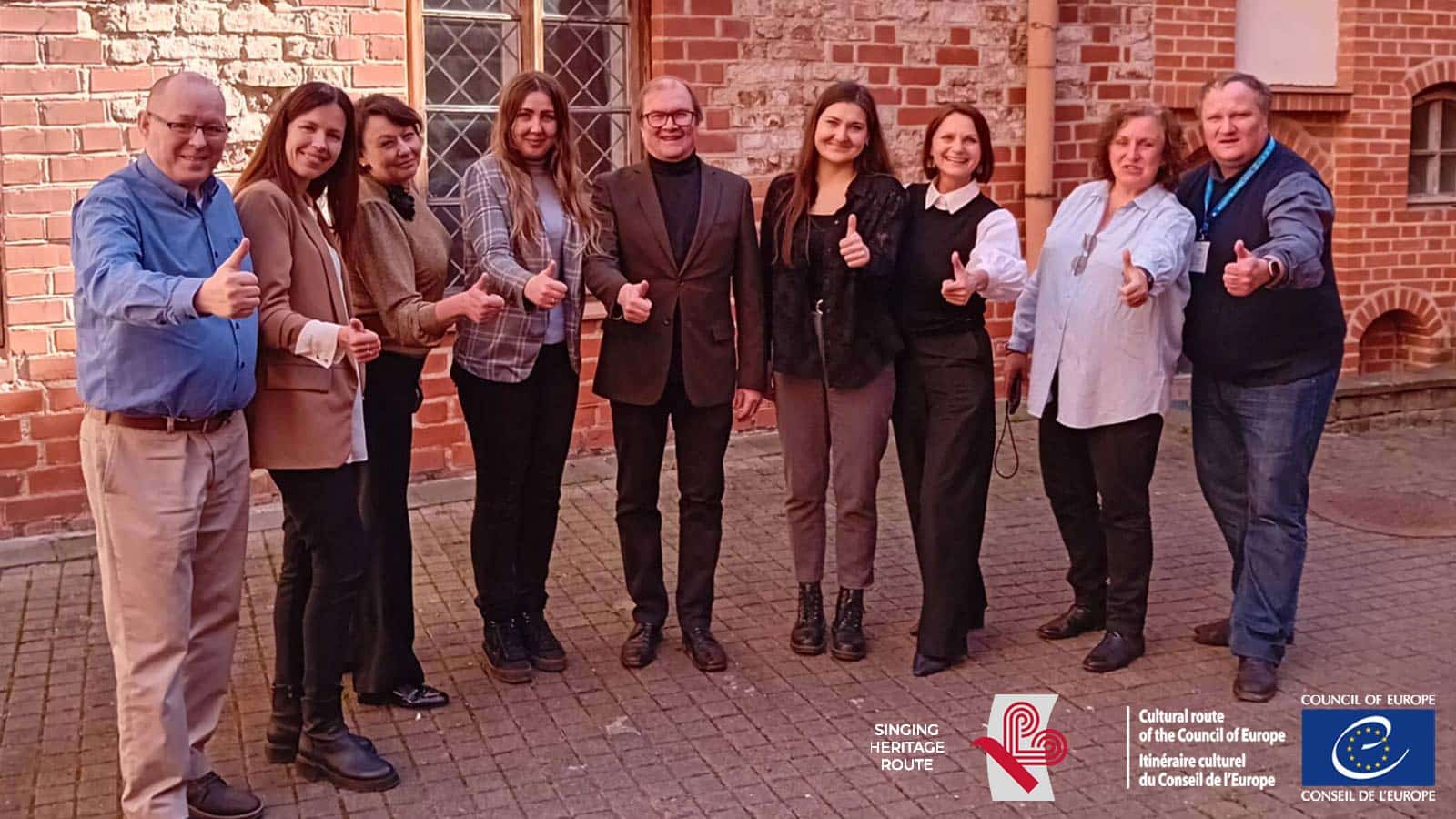
The Singing Heritage Route celebrates. From left to right: Rune Bjerkli, Vaiga Landauskienė, Katriina Leppänen, Gabrielė Brazauskienė, Pekka Huttu-Hiltunen, Greta Andriuškaitė, Sarmite Teiváne, Gita Lancere, and Kristjan Raba.
The Singing Heritage Route has received certification as a Cultural Route of the Council of Europe. This certification is a significant international recognition for singing traditions and for the long-term development work carried out by the route network.
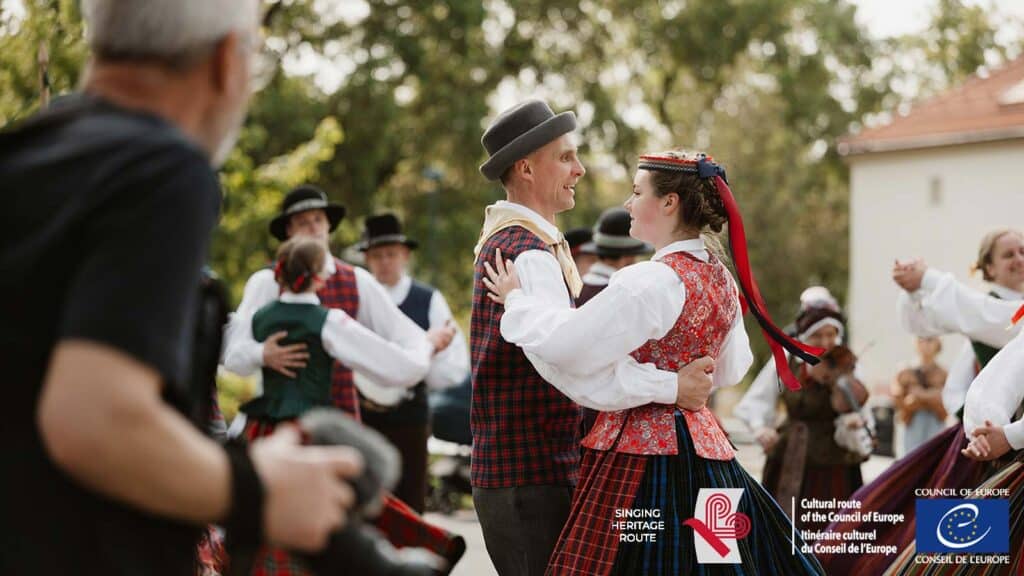
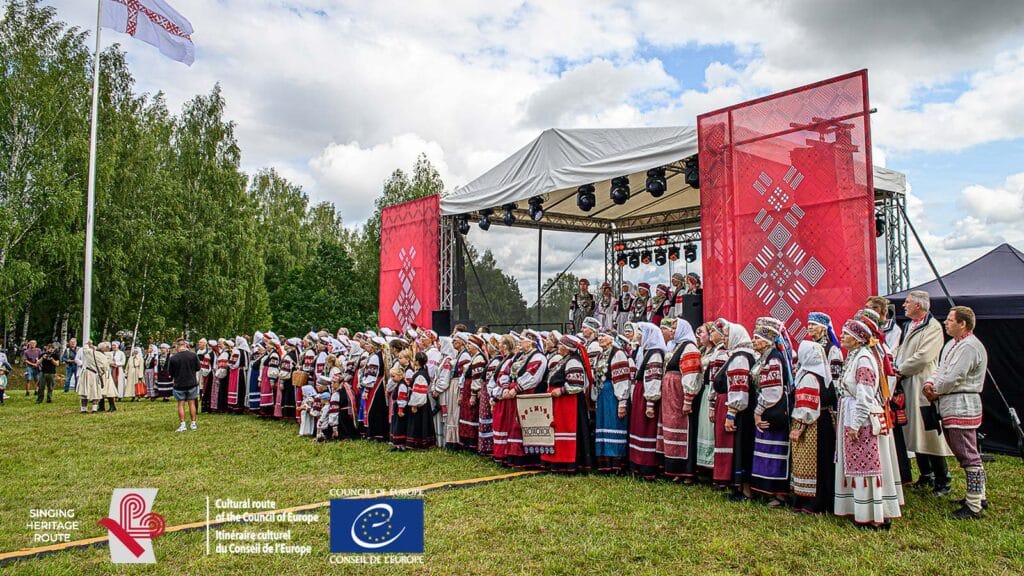
The Singing Heritage Route brings together culturally significant singing traditions across Norway, Finland, Estonia, Latvia, and Lithuania. The route connects, among others, the Kven/Finnish singing tradition in Norway; the Sámi joik, luohti, and leu’dd traditions across northern Norway and Finland; the runo-song tradition in Finland, Estonia, and Norway, including the Seto leelo tradition; the singing traditions of eastern Latvia, including multipart singing and singing with pusbols; and Lithuania’s sutartinės singing tradition. The Baltic song and dance celebration tradition is also part of the route’s thematic content.
During the certification process, the route’s strengths were identified as its strong scientific foundation, demonstrated through active research collaboration, as well as its thematic contribution, which enriches the Cultural Routes of the Council of Europe programme by bringing perspectives related to minorities and intangible cultural heritage.
The international cultural route is managed by the Singing Heritage Route Association, registered in Finland, which coordinated the application to the Cultural Routes of the Council of Europe programme.
“Certification as a Cultural Route of the Council of Europe is a wonderful recognition for the region’s singing traditions. The programme also provides guidelines for developing cultural heritage and cultural tourism while supporting the continuity of operations,” says Anni Alho of the Finnish Heritage Agency.
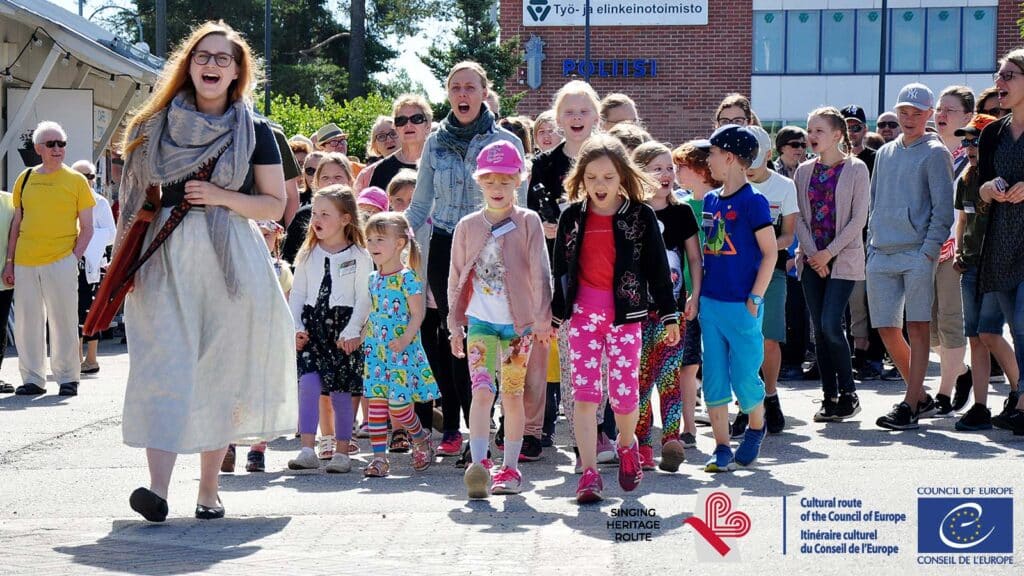
Singing traditions can be experienced through festivals and events organised by members of the route network. In Finland, these include the Sommelo Folk Music Festival in Kuhmo and the Kihaus Folk Festival in Rääkkylä, both held during the summer. In Estonia, examples include Seto Kingdom Day, as well as exhibitions, concerts, lectures, and community singing events. Similar activities take place across all participating countries.
The Cultural Routes of the Council of Europe Promote Shared European Heritage
The Cultural Routes of the Council of Europe programme is rooted in the 1987 Santiago Declaration, which emphasised the importance of the ideals of freedom, justice, and mutual confidence in shaping European cultural identities and overcoming distances, borders, and language barriers. Cultural Routes are recognised as playing an essential role in raising awareness of Europe’s shared heritage as a cornerstone of European citizenship, a means of improving quality of life, and a source of social, economic, and cultural development.
The Cultural Routes of the Council of Europe are internationally recognised cooperation networks in cultural heritage and tourism that highlight Europe’s shared cultural heritage and promote sustainable cultural tourism. In addition to tourism development, the routes are expected to engage in research-based activities, implement cultural heritage education initiatives, and connect cultural heritage with contemporary culture and the arts. Cultural Routes bring together stakeholders from at least three countries, including museums, research organisations, associations, and tourism operators.
The programme is based on the Council of Europe’s Enlarged Partial Agreement on Cultural Routes.
For further information:
Pekka Huttu-Hiltunen
+358 40 1798600
[email protected]
Sari Kaasinen
+358 50 5640930
[email protected]
[email protected]